

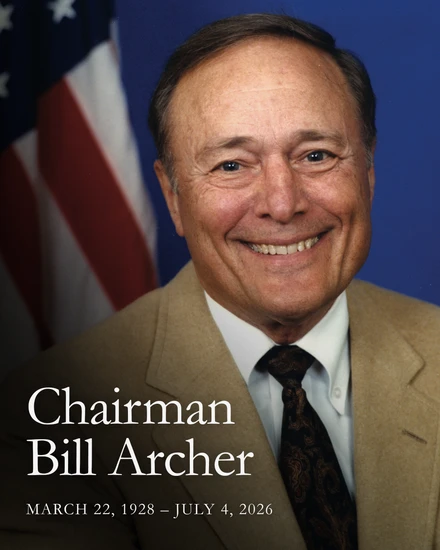
The Bill Archer I Knew, by Anne Clutterbuck
I first met Mr. Archer in 1982, when I was a college intern in his Washington, D.C., office. I was a young, naïve student, yet Congressman Archer often welcomed me into his office to talk about ideas and public policy. He would listen patiently to my thoughts, then, in the fashion of his favorite Stoics, ask me questions. That experience changed my life. He helped me apply a framework to my nascent love of law and public service. I would go on to work for him for 15 years. It was the best job I ever had. Archer, a product of Houston, Texas, was born at St. Joseph’s Hospital and raised in the Heights and River Oaks. He often said that his character was shaped by those years with his parents, time spent at St. Thomas High School, and his experience as a small businessman in Houston.
Famous for preparing his own taxes (notably while serving as chairman of the tax-writing House Ways and Means Committee), he was a champion of the common man and believed the tax code should be fair and simple enough for anyone required to file taxes. The tax-related policies he championed were designed to honor the dignity of every American, encourage savings, and support individual initiative and the American family.
Astonishingly, Congressman Archer never accepted a dime of PAC money for his campaigns. He viewed his role of spending other people’s money as a sacred trust. Notoriously thrifty, those who knew him will smile at the memory of his many personal examples of financial stewardship.
Archer was known and admired for many accomplishments over his 30 years in Congress, including notable legislation that millions of Americans benefit from to this day. But the thing I will remember him most for was the remarkable way he conducted himself in public office: respectful, kind, attentive, and responsive.
A point of pride upon leaving office was that he never publicly said an ill word about any of his colleagues. Thirty years of negotiations and quarrels in Congress produced a fair share of disagreement, but he worked mightily to never be disagreeable or personal. Bill Archer did not believe in politics as personal sport.
A deeply religious man, he made his faith his North Star. As a Christian, he believed the words of Jesus’ great commandment: love your neighbor as yourself. I saw this belief in action. Archer embraced the dignity of his neighbor. His neighbor was whomever he met. Foundational to his approach was to treat everyone he met with respect.
In the days since his passing, I have heard from friends across the political spectrum who have praised Bill Archer: “American hero,” “A gentleman who earned almost everyone’s respect,” “Citizen patriot,” “True public servant,” and perhaps my favorite, “The politician both my parents could agree on.”
In our more recent conversations, he wondered aloud whether he could get elected today. The vitriol and personal attacks that have become part of the daily rage machine of politics broke his heart. He loathed the pressure placed on members of Congress to raise more and more money for campaigns and PACs.
When he first ran for Congress in 1970, the country was torn apart by the Vietnam War, struggles for civil rights, and a new military draft. America was fiercely divided, and young people felt an enraged detachment from their government. Meeting them on the campaign trail greatly affected Archer. He vowed to work to restore confidence in elective office.
The Archer Intern Program began that year and continued for thirty years. He would bring one junior from each high school in his district for a weeklong trip to Washington, D.C. Funded by private donations, the week was packed with meetings with members of the House and Senate, Executive Branch, and the Supreme Court. It was a rigorous experience. Students were encouraged to be prepared, to feel free to ask any question, and to do so with respect and genuine curiosity.
That program led to the formation of the Archer Center at The University of Texas System. Along with providing opportunities for students to engage in public service, the hope is to raise a new generation of passionate citizens who can enter the public arena armed with ideas, civility, and mutual respect.
When I last saw Congressman Archer at his home in December, he was as sharp as ever. We talked about what he was reading that week: John Meacham’s biography of Thomas Jefferson, and "A Day in the Life of Ivan Denisovich" by Aleksandr Solzhenitsyn — a story of survival and the fight for human dignity in the face of oppression. I wish we could have had one more conversation about that.
May his memory and legacy be a call to each of us to lay aside our acrimony and engage in the passionate and respectful exchange of ideas. And may we together continue the work to improve our communities.
Anne Clutterbuck is a former member of Houston City Council and served as Houston’s Mayor Pro Tem.